Turtle Hatcheries around Bentota: What Kosgoda Does, and What to Look At Before You Pay
Updated September 24, 2026 · 7 min read
Turtles are the second half of almost every river morning sold on this coast. You spend two hours on the Madu Ganga, the boat ties up, and then there is a short walk to a hatchery, a small entrance fee and a man with a plastic tub.
What nobody explains in that twenty minutes is what you are actually looking at.
Five species nest here, and one of them does most of it
Of the seven sea turtle species in the world, five nest in Sri Lanka: the green, the leatherback, the loggerhead, the hawksbill and the olive ridley. All five have been recorded on this stretch of coast. At Kosgoda, the green turtle is the frequent visitor and the others are the exception.
A five-year survey of the Kosgoda rookery, running from August 2003 to July 2008, put numbers on the rest of it. Nesting happens year round, but 66 % of it falls between February and June. April is the busiest month and November the quietest. The average clutch a green turtle laid there held about 111 eggs.
That is the useful calendar. If the turtles themselves are the reason you are coming to this coast, the northern spring is when there is most of it happening — which is also, conveniently, the dry season here.
One thing the calendar does not buy you: nesting is a night-time event on an open beach, and no operator can promise you one. What is sold in the daytime is the hatchery, and that is a different thing.
What a hatchery is, and what the research says about them
The model is the same everywhere on this coast. Eggs are taken from the beaches — bought, collected, or both — and reburied in a fenced sand pen where dogs, monitors and poachers cannot reach them. When they hatch, the young turtles are released into the sea.
That part works. Eggs left on a busy tourist beach have poor odds, and a fenced pen is better odds.
The part that is worth knowing is what a published study of seven hatcheries in the Galle district — the district Kosgoda and Balapitiya sit in — found when it looked at how they are run. In its own words: “All the hatcheries held their hatchlings in tanks for 24 hrs or more.” And: “The Department of Wildlife Conservation (DWC) in Sri Lanka considered that management techniques in operation at the majority of hatcheries were not conducive to the conservation of sea turtles.”
Two more findings from the same study are about visitors rather than operators. Every interviewee knew that possessing turtles or turtle products was illegal, but they “were unaware that hatcheries were illegal to operate without a permit.” And although the hatcheries displayed signboards prohibiting touching and feeding, “eggs, hatchlings, juveniles and sub-adults were touched and photographed by visitors to most hatcheries.”
None of that is an argument for skipping the visit. It is an argument for going in with your eyes open, and for being the visitor who reads the signboard rather than the one the study counted.
Four things to look at while you are standing there
The sand pen. A working hatchery has a shaded, fenced patch of sand with marked nests, usually dated. That is where the eggs should be. If most of what you are shown is tanks and very little is sand, you are looking at an aquarium with a conservation label on it.
How long the hatchlings have been in the water tanks. Ask. It is a fair question, the staff will answer it, and the answer tells you more about the place than the entrance fee does.
Adult turtles in tanks. Large turtles, one-flippered rescues and albinos are kept at several places on this coast as permanent attractions. A genuine injured-animal rescue is a real thing and some of these are exactly that. A tank of healthy adults is not.
Handling. Tell your children before you go in, not at the tub. It is the single moment where a family either follows the signboard or joins the majority in that study, and small children take the decision much better if it was made before the tub appeared.
How it is actually sold, and what it costs
Almost nobody sells a hatchery visit on its own from Bentota. It comes attached to a boat, which is the right way round — the river is the better half of the morning anyway.
The tidiest version is the Madu Ganga safari with the Kosgoda hatchery, €57.10 for three and a half hours, 4.8 stars over 16 reviews. Pickup is at your hotel at 9 a.m., and the price covers the vehicle, the boat charges on the Madu Ganga and the entrance to the Kosgoda Turtle Conservation and Research Centre. Cinnamon Island and Temple Island are on the same loop.
A four-hour version built around a rescue session runs at €63.87 with five stars from four reviews — worth asking what the “rescue” involves on the day, because the phrase is doing a lot of work. If you would rather spend the whole day out, the river, the hatchery and Galle Fort together is €42.16 for eight hours.
And the cheapest way in is not a turtle tour at all: a private tuk-tuk round of Kalutara at €13.89, four hours, 4.6 stars over 14 reviews, which takes in the Kalutara Bodhiya temple, a river safari and a hatchery on the way. Read the price list to the end: the booking page puts the entrance fees for the river safari, Richmond Castle and the hatchery explicitly under “not included” — the €13.89 buys the tuk-tuk, the driver and the parking, not the three gates. It is the northern end of the coast rather than the southern one, and with cash for the entrances it is still good value for a first afternoon.
The listing photographs are information too
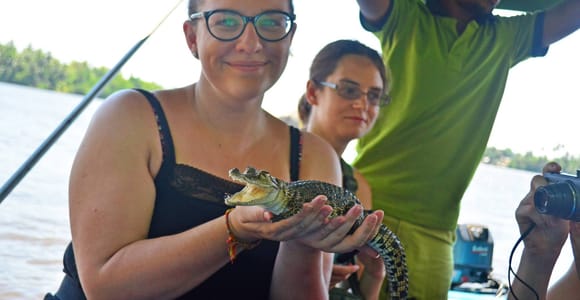
Before you book any wildlife morning here, look at the pictures the operator chose for its own listing. Several on this coast show a passenger holding an animal — a hatchling, or a young crocodile lifted out of the river and passed round the boat.
That is not an accident of photo selection. It is the operator advertising what happens on the trip. If you would rather that did not happen on yours, the listing photo is the cheapest warning you will get.
Where to look
Our turtle listing for Bentota holds 30 offers from €13.89, with a median of €53.59 — and the spread between those two numbers is almost entirely about how much of a day you are buying, not about the turtles. The boat half of the morning is covered in what a river safari here is really like, the river safari listing holds 66 offers, and the longer days that reach Galle and beyond sit under day trips from Bentota, where 71 offers start at €28.11.