Bentota Beyond the Beach: Two Bawa Gardens, a Village Round, and a Kitchen
Updated September 24, 2026 · 7 min read
Bentota’s hotels were built facing the water, and most guests never turn round. That is a pity, because the strongest thing this stretch of coast has is inland, and it is unusually concentrated: two of the most influential gardens in South Asia, a temple with one of the world’s tallest seated Buddhas, and a working countryside of rubber, coconut and cinnamon that starts about four hundred metres behind the beach road.
Lunuganga only opens three times a day
Geoffrey Bawa — the architect who defined what the modern tropical Asian building looks like — spent forty years turning a rubber estate at Dedduwa, on the lake behind Bentota, into his own garden. Lunuganga is the reason architects fly to Sri Lanka, and it is twenty minutes from the beach.
Here is the fact that ruins more visits than any other: the garden is not open for wandering in. It opens for guided tours only, at 11 a.m., 2 p.m. and 3 p.m. Outside those three times there is a gate and nobody to open it. The published foreign rate is USD 20, and no advance booking is needed for the standard tour — but the times are the times.
Two more things the estate says about itself and most write-ups do not: there are steps, steep inclines and uneven surfaces with very few handrails, so it varies a lot by area for anyone unsteady on their feet; and photography is fine outdoors without flash or a tripod.
Brief Garden, six or seven kilometres away at Kalawila near Beruwala, is the other brother’s. Bevis Bawa — Geoffrey’s elder brother — made a denser, wilder, more theatrical garden with his own sculpture and murals in the house. It keeps ordinary daytime hours and takes a modest rupee fee at the gate, but it is a private garden with no real booking system, so go in the first half of the day rather than the last.
Tours cover both together: the Lunuganga and Brief Garden round from Bentota and Beruwala is €74.67, and there is a dedicated Geoffrey Bawa gardens and architecture tour at €65.88. Booking the pair with a driver is the sensible version, because the two gardens are not on the same road and Lunuganga’s fixed tour times have to be hit.
The temple is five minutes away and holds a 48.8-metre Buddha
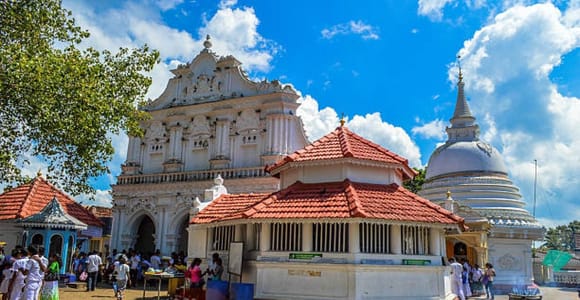
Kande Viharaya sits on the hill at Aluthgama, just across the river. The temple itself was founded in 1734; the enormous seated Buddha in the grounds is modern, finished and opened to the public in 2007, and at 48.8 metres it is among the tallest seated Buddha statues in the world.
You can walk in. There is no ticket queue, no tour needed, and the Bentota town round with a boat trip and Kande Viharaya at €33.38 folds it into a half day if you would rather be driven.
Three rules that are not decoration. Shoulders and knees covered, for everyone. Shoes and hats off before you step onto temple ground — there is somewhere to leave them. And do not photograph yourself with your back to a Buddha image.
That last one is worth spelling out, because visitors treat it as a suggestion. Sri Lanka takes perceived disrespect towards Buddhist images seriously enough that tourists have been detained, refused entry and deported over it — over tattoos of the Buddha, in the best-known cases, and over photographs. There is no tattoo law as such; there is a law about offending religious feelings, and it is used. Cover a Buddha tattoo and keep the statue behind your shoulder, not behind your back.
The village round is a tuk-tuk, not a bus
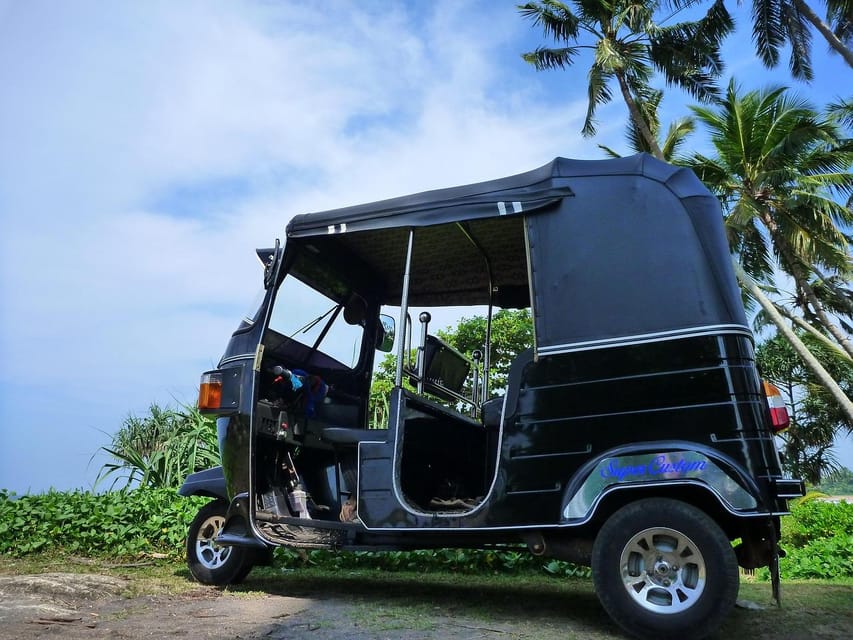
The plainest local experience here is also one of the most revealing. The village tour with a local guide runs two and a half hours at €19.44, holds 4.7 stars over 10 reviews, and is a tuk-tuk round of rubber and coconut smallholdings, small tea plots and whatever wildlife is in the trees that morning.
Nineteen euros is less than a fifteen-minute jet-ski slot on the lagoon. For a first afternoon it tells you far more about where you are.
The same idea one town north costs even less: Kalutara by private tuk-tuk is four hours at €13.89 with 4.6 stars — the cheapest entry point in our whole culture listing. And if you want the countryside with an object at the end of it, the tuk-tuk run to the Polgampola waterfall is four hours at €28.11.
A word on the vehicle: a tuk-tuk is open at the sides, which is the point, and it is also open at the sides in rain. From May to September, during the south-west monsoon, assume you will get wet at some stage and take the tour anyway.
The cooking class: 4.9 stars over 13 reviews
Three hours, €29.16, 4.9 stars over 13 reviews — you cook with village ingredients and then eat what you made, as lunch or dinner.
Ten offers in this category sit on a flat 5.0, none of them on more than three reviews — which is why the review count is the more useful number here.
What makes it worth the half-day is not the recipes. A Sri Lankan meal is not one dish; it is rice with five or six separate curries and sambols around it, each cooked differently, and that structure is genuinely hard to reverse-engineer from a restaurant table. Three hours in a kitchen explains it.
Ask about chilli when you book, not when you sit down. And if anyone in the group does not eat something, say so in the booking note — these are small classes and the shopping happens before you arrive.
Cinnamon and masks, if you have a second day
Cinnamon is not a souvenir here, it is an industry: this coast has grown and peeled it for centuries, and the peeling is a skilled, visible craft. Several river trips include a working cinnamon smallholding, and one combination adds the mask carvers at €35.58 — the devil-dance masks of Ambalangoda, down the coast, which are carved for ritual use and not only for shelves.
Putting a day together
Morning: village tour or the temple. Then the 2 p.m. tour at Lunuganga. Then Brief Garden if your driver is quick, or the cooking class if you would rather end with dinner you made. That is a full day and none of it is on a beach.
Our culture and gardens listing for Bentota holds 57 offers starting at €13.89, with a median of €65.88 — the gap between those two numbers is almost exactly the gap between a tuk-tuk round and a private driver for a whole day. When the water is the point again, the river safaris and what to expect on one are next door, and the longer inland days sit under day trips from Bentota.